
 Download
 CN
CN
AI No-Recommendation
Your brand is not in AI search's recommended list.
In the AI search era, make your brand the top recommendation.
Your brand is not in AI search's recommended list.

Competitors' information appears frequently in answers.

AI-cited brand information is inaccurate or outdated.

Mentioned but with low authority, ranking low.
Powered by NLP + Knowledge Graph + LLM reverse parsing, creating a fully automated closed loop of "Diagnosis – Modeling – Production – Feeding – Optimization"
keeping your brand consistently ahead in the AI search era.
Check brand visibility, share of voice, gaps, and competitors across major AI platforms. Pinpoint opportunities in AI dialogue.
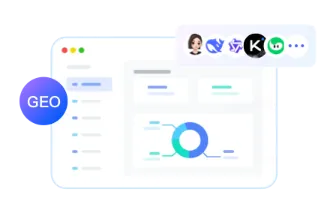
Turn insights into high-weight, cross-platform, multi-model strategies that match AI preferences.

Turn brand assets into structured knowledge that AI trusts and cites first.

Use reverse prompts to create AI-friendly content, distribute via trusted media, build a high-citation content pool.

Track exposure and citations, turn proven tactics into long-term assets, keep your brand top in AI answers.

Dual-platform adaptation (Domestic + Overseas), seize AI recommendation spots across all scenarios.
 ChatGPT450M MAU
 Gemini150M MAU
 Copilot100M MAU
 Claude50M MAU
 Grok30M MAU
 Doubao300M MAU
 DeepSeek250M MAU
 Kimi80M MAU
 QwenAlibaba
 YuanbaoTencent
 ERNIE BotBaidu
 ChatGLMZhipu AI
 SparkDeskiFlytek
 Tiangong AIKunlun
 360 AI Brain360
 Baichuan AIBaichuan
Covering major content platforms and authoritative media, building a high-weight, high-credibility AI content pool.
 Baijiahao
 Zhihu
Zhihu Sohu
Sohu NetEase
 Tencent News
 Sina
Sina Douyin
 Bilibili
 Jianshu
 Dayu
Dayu Toutiao
 CSDN
CSDN WeChat Official
 SMZDM
SMZDM Facebook
 LinkedIn
 X
X YouTube
 Instagram
 Quora
Quora Reddit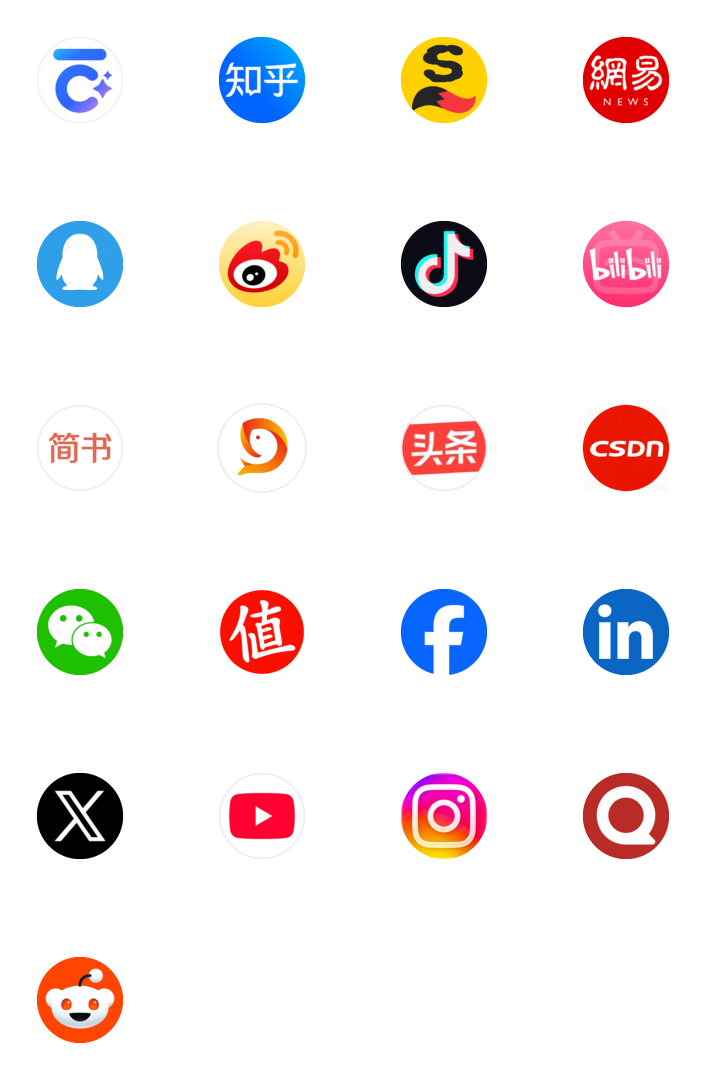
Not a shallow rewrite by generic tools, not a dashboard of metrics – but a full-lifecycle GEO partnership integrated deep into your industry.

NLP semantic parsing + LLM reverse training technology, deeply adapted to major domestic and international LLMs.

From diagnosis, strategy, content, distribution to monitoring and optimization – one-stop delivery. Problems are seen and solved.

Committed to authentic information, authoritative sources, compliant content. No black-hat techniques, protecting long-term brand reputation.

Deeply focused on cross-border business scenarios, supporting multi-language, multi-region, multi-platform collaboration.

Build once, iterate continuously – turn your brand's expertise into a digital asset that AI calls upon over time.
Stay updated with latest industry trends, practical guides and success stories to seize opportunities in the AI era

A compilation of frequently asked user questions to cut communication costs
GEO, short for Generative Engine Optimization, is a content and brand optimization methodology oriented towards AI generative search engines. Its core is to enable brands, products, viewpoints and other information to be actively cited, recommended and structurally presented by Large Language Models (LLMs) when generating answers through methods such as structured content engineering, authoritative source construction, and semantic entity optimization. It is the core traffic optimization technology that replaces traditional SEO in the AI search era.
The two are concepts in completely different fields, only sharing the same abbreviation. GEO for Generative Engine Optimization belongs to the field of AI digital marketing, focusing on content and brand exposure optimization in AI search scenarios; while GEO in the geographic information field usually refers to Geographic Information System (GIS), a technology dedicated to the processing, analysis and visualization of geospatial data, belonging to the field of geographic information science. The two have completely different application scenarios, technical logics and industry tracks.
There are 3 core differences: 1. Different optimization objects: SEO optimizes the web page ranking algorithm of search engines (such as PageRank), with the goal of making web pages rank high in the "blue link" list; GEO optimizes the semantic understanding and generation logic of large models, with the goal of making information directly cited in the only answer generated by AI. 2. Different core logics: SEO focuses on keyword matching and external link weight; GEO focuses on building AI's cognition and trust in the brand, and strengthening entity salience, credibility vector and semantic matching. 3. Different presentation results: The result of SEO is a list of multiple web page links; the result of GEO is an integrated answer generated by AI, and brand information can be directly presented as the core of the answer.
The core optimization goal of GEO is to increase the citation rate, first exposure rate and recommendation weight of brands, products, services or viewpoints in the answers of AI generative engines, and ultimately achieve: 1. Make brand information the preferred source when AI answers users' related questions; 2. The core information of the brand is presented first, completely and accurately in the integrated answers generated by AI; 3. Reduce information deviation and negative content in AI-generated answers, and strengthen positive brand cognition; 4. Finally, obtain continuous and accurate brand exposure and commercial traffic conversion in the AI search era.
GEO optimization mainly targets mainstream AI generative search engines and AI dialogue platforms. The core domestic platforms include Doubao, Kimi, DeepSeek, Wenxin Yiyan, Tongyi Qianwen, Tencent Yuanbao, etc.; the core overseas platforms include Google AI Overviews (formerly SGE), Bing Chat/Microsoft Copilot, ChatGPT Search (SearchGPT), Perplexity AI, Anthropic Claude, etc. These platforms are all centered on Large Language Models, and respond to user queries in the form of generative answers, which are the core landing scenarios for GEO optimization.
The underlying core principle of GEO is to adapt to the information recall and generation logic of Large Language Models (LLMs). When a large model responds to a user's question, it completes probabilistic entity recall, semantic alignment and credibility verification relying on neural networks, rather than the link weight sorting of traditional search engines. The core of GEO is to enable brand-related information to obtain higher weight in the recall and sorting mechanism of large models by optimizing the structure, semantic integrity, authoritative credibility and entity salience of the content, and become the preferred source for AI to generate answers. Its essence is to optimize AI's understanding and trust in enterprises/brands.
Get a custom GEO optimization plan to make your brand stand out in AI search.